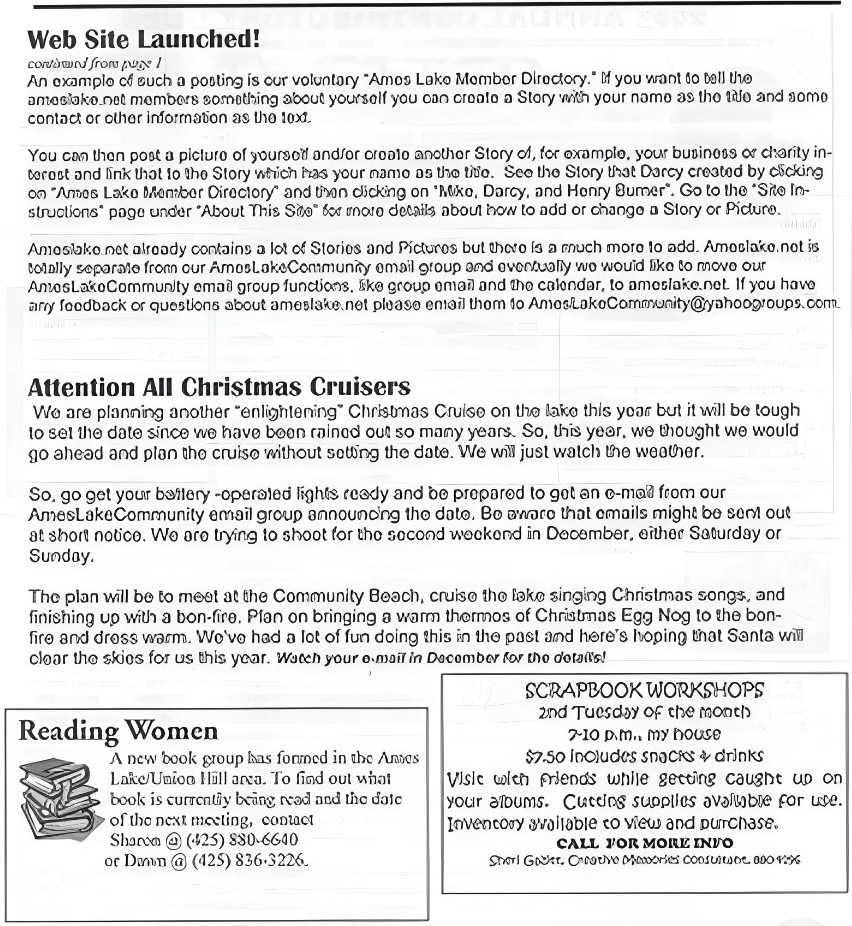
This is an image of a 2003 Ames Lake newsletter. Members were encouraged to post stories on our first community website.


![]()
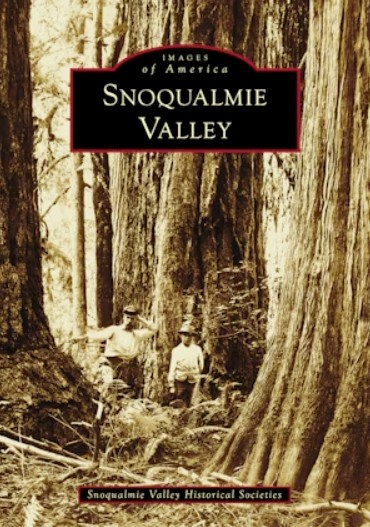
A look at our community's past
This is an image of a 2003 Ames Lake newsletter. Members were encouraged to post stories on our first community website.


![]()
Until the 1890s, there were no bridges over the Snoqualmie River, so people used canoes to cross it.
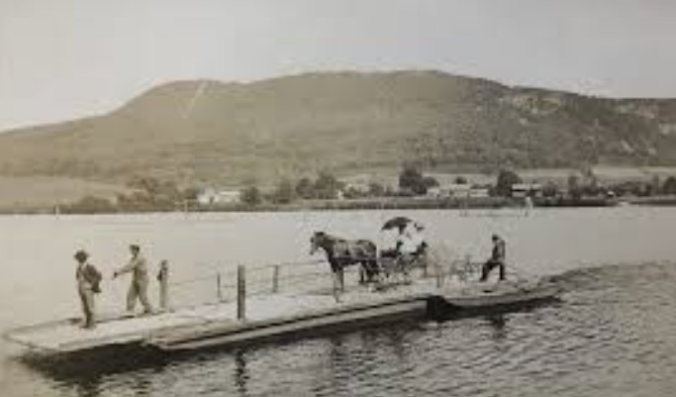
As more wagons and teams came onto the scene, ferries emerged. One of the first was owned by James Duvall. It was located where the Woodinville-Duvall bridge is now.
Some ferry crossings were operated using a system of ropes or cables to pull the vessel across the river. Passengers pulled the ropes to assist the operator.
The Fall City ferry, built in 1885, was a wooden, cable-operated ferry used to get across the river into town.
In the early 1900s, John Ames established a cable ferry at the current site of MacDonald Park and West 40th Street.
Water transportation remained important for commercial and passenger travel until the railroad’s arrival in 1910. The development of roads and bridges eventually led to the decline of ferry crossings on the Snoqualmie River.
![]()

Until the railroads arrived in 1910, water travel on the Tolt and Snoqualmie rivers was used for commercial and passenger transport. The earliest settlers used canoes. Eventually, these were replaced by steamboats. It was difficult for the steamers to maintain dependable schedules, as it was not unusual for the vessels to get stuck in shallow areas. When that happened, they had to run a line to a tree on shore and use a winch to haul themselves through the river channel.
The steamers hauled passengers and freight, which included both produce and livestock. If the animals fell overboard, the crew had to round them up in lifeboats. Steamers would also serve as towboats and could often be seen towing a large boom to another port down steam.
The Alki steamboat
The Alki began navigating the Snoqualmie River around 1875. It was a small, light draft steamboat owned by Brown and McCall. The Alki was probably the only boat making regular trips upstream from Snohomish at the time.
Ames Ferry Landing
In the early 1900s, John Ames established a ferry service near his home on the west bank of the Snoqualmie River, across from what is now Tolt-McDonald Park. His ferry ran on a cable stretched across the river, and passengers were charged a small fee for transport – 10 cents per person and 25 cents for a horse and wagon.
Ames also built a resort hotel on this site, and for a time it was a popular retreat for Seattle residents. Ames operated only a few years, as he left the area after his son was killed working on the railroad. Ames Lake is named in his son’s honor.
![]()
In 1953-1954, Dave Egan, a longtime resident of our community, started coming with his family to Ames Lake. They camped in tents.
During that time, the lake was sometimes filled with logs and other debris from logging on the northeastern side of the lake. Families spent hours pulling lumber from the water before they could go swimming.
![]()
The ALCC annual meetings were once held at the Vincent Schoolhouse. Before the meetings, there was always a potluck or “free lunch” supplied by the Community Club.
In 2006, one of the meeting topics was about the things our dues paid for, such as the Community newsletters, testing the lake water, keys, insurance, and more – much as they are now.
![]()

Check out the order form and the items for sale.
![]()
© 2026 The History of Ames Lake
Theme by Anders Noren — Up ↑