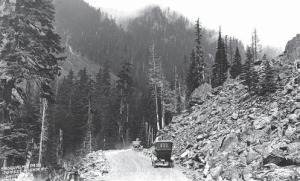
As the lower Snoqualmie Valley floor was cleared of forest, farms were developed through the 1860s to the 1880s, providing a variety of crops to local markets. For several decades, these crops were transported to market via flat-bottomed river steamboats.
Up until the early 20th century, area residents crossed the Snoqualmie River in personal small crafts, or at strategic ferry landings. In the village of Tolt, a cable-operated ferry was situated on the river at the Ames Landing site, now MacDonald Park and West 40th Street.
Roads were built for wagons and cattle, as well as coal and lumber activities. These early roads were crude and seasonally impassible due to heavy snow, rain, and mud.
West Snoqualmie Valley Road
In the late 1880s, population growth in the Snoqualmie Valley spurred the construction of the first north-south wagon road. It traveled down the east side of the valley, running north toward Snohomish City.
Snoqualmie Valley Road was largely in place by 1890. New dwellings and barns were constructed along the road at the valley’s edge, rather than on the valley floor. The settlements of Fall City, Tolt (Carnation), Novelty, and Cherry Valley (Duvall) benefited from this road, now SR 203.
By 1912, the road continued along the hillside south of Novelty to the little settlement of Vincent and beyond.
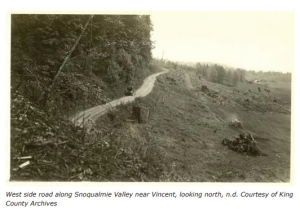
Along this road, westside farm children could walk to the Vincent Schoolhouse (now a King County Landmark), overlooking the Snoqualmie Valley at NE 80th Street. The one-room school served grades one through eight until 1942.
In 1932, West Snoqualmie Valley Road proceeded along the length of the valley. Carnation Farm Road was also improved by that date and has the same configuration as it does today.
Sources: King County records, King County Historic and Scenic Corridors Project
