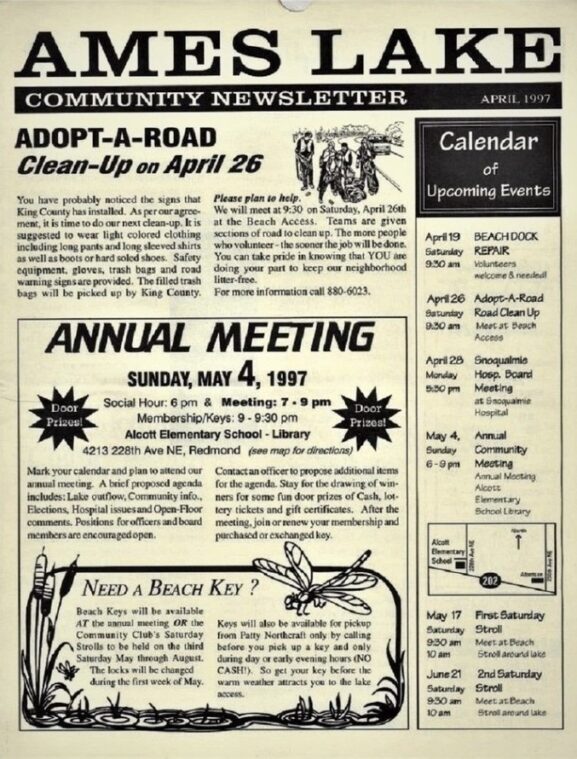
This is an Ames Lake community newsletter from 1997. Some issues (road cleanliness, beach keys) are still with us today.

A look at our community's past
This is an Ames Lake community newsletter from 1997. Some issues (road cleanliness, beach keys) are still with us today.
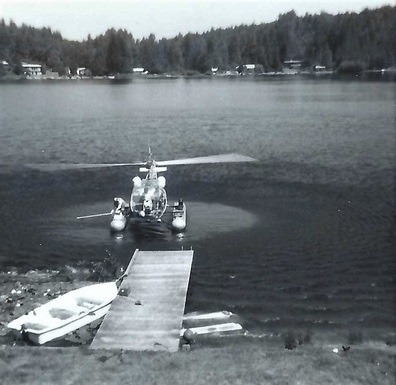
In July of 1973, the Department of Ecology landed a helicopter on the lake to test the depth and quality of the water. It was quite an event!
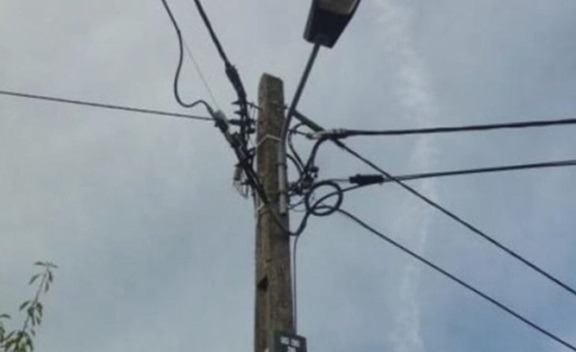
On February 8, 1954, power finally came to Ames Lake. People put away their kerosene lamps, hand-winding alarm clocks, and battery radios. They brought in refrigerators, televisions, electric stoves, power tools, and vacuum cleaners.
A one-man cooperative, Mutual Power and Light, was able to do the job in this sparsely settled area. The “one man” was A. Cone Hunter, manager, lineman, foreman, groundman, and public relations expert.
There was a direct hookup with Puget Sound Power and Light, who completed the process and installed transformers. Their crews went to the homes of each permanent resident, fastened service wires to the wires running into the house, and installed a meter.
With the power in, Ames Lake was brought up to date, and people were looking into a future of real estate booms. They hoped for two other services that were not yet available: a rural mail route and a telephone line.
Today, Tanner Electric serves the Ames Lake area. You can read about their history here.
Ames Lake was first logged in 1927 by Siler Logging. The lake had been used as a holding pond. Logs were kept there until they were loaded onto railroad flatcars and sent to the mills.
In 1946, railroad pilings were still left in the lake, as well as hundreds of lost and discarded logs. That year, a man named Jim Jackson, along with a friend, used a hand-winch to get the derelict logs to shore. They cut them up and sold them to a nearby mill.
John Ames came to Tolt in the early 1900s. John Ames’ son Arthur was killed while working on the railroad. His father named Ames Lake in his honor.
Ames built a home for his family across the Snoqualmie River from the Tolt River, now Tolt – McDonald Park. A trail from the Ames home over the hill connected to the road to Redmond. The trail was eventually widened into a good road.
Ames built a ferry, which ran on a cable. He charged a small fee to carry passengers and wagons across the river. This was a popular way for the people of the Tolt community to travel: across the river by ferry and over the hill.
Ames built another building, separate from their home. He called it “The Blue Front” and took in paying guests. He drove a hack to Seattle, stopping at the Deller Hotel to tell visitors about the great fishing and hiking in the Tolt area. It wasn’t long before he convinced people to come and spend a week at his resort hotel.
The Washington Supreme Court permanently ordered the state from permitting public access to Ames Lake and its property. The idea was that the state be restricted from using the property for other than residential purposes.
The Plat of Ames Lake, an addition to King County, Washington, included the lake and all the property immediately adjacent to it. The lake itself was Lot A and around it were Lots 159 inclusive.
Lots B, C, D, and E were interspersed at intervals among these lots, which also abutted the lake. They couldn’t be sold, as they gave owners of lots with no convenient lake frontage to access the lake.
A second tier of lots, 160 to 279, were separated from the waterfront lots by a 60-foot roadway designated “Scenic Blvd.” It went entirely around the lake.
The Plat contained the following statement: “As shown on the Plat Lots designated as Lot A, which is Ames Lake, and B, C, D, and E are the undivided and common property of the owners of all Lots in this Plat. The development, maintenance, and upkeep of A, B, C, D, and E are a joint obligation of said lot owners and subject to such rules and regulations governing same.”
© 2026 The History of Ames Lake
Theme by Anders Noren — Up ↑