The History of Ames Lake

A look at our community's past

Page 6 of 6

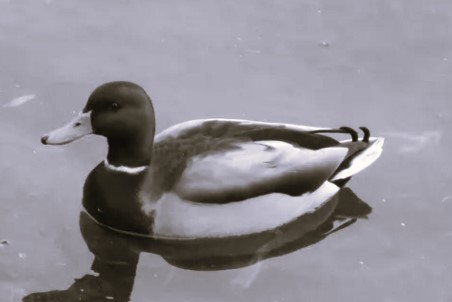
One of the Last Ames Lake Ducks

I am a beautiful male mallard duck, and for the past few years my buddy and I cruised the lake together because there is only one female duck left on the lake. We were hoping to get mates someday because we love this lake and the people and the surroundings.

My buddy was my best friend and we went everywhere together searching for food, amusing mankind, and protecting each other from dogs and stuff. Many of you folks who live on the lake know us by the special groups that we cruise in as we are together forever. We like to check out the new houses and new families and make sure that we don’t get in anyone’s way. We just want to look good and live.

But on Sunday, April 6th, two teenagers came out in their boat with rocks, and they threw them at us. My best buddy was hit in the head. A lady jumped into the lake to save him. She took him to her house, but it was too late. His head was split open, it was bleeding, and his neck was broken. He died on her kitchen counter while she was frantically calling vet hospitals.

The families of the teens are dealing with them and I am told that he was properly buried. Every day, I go back to the spot where his life ended, hoping to see him again, but I know I will not, and I am so alone.

We ducks just want to add some serenity to the lake, give you members something beautiful to watch growing up, and we try to stay out of the places we don’t belong. Please don’t hurt us, as I am one of the last Ames Lake mallards.

Quackerly yours,

A Duck

Ames Lake Stirs Up Water Controversy

In 1965, a group of residents in this area petitioned the King County Commissioners to form a water district. The proposal precipitated a protest. The opposition’s main argument was that the population in the area did not warrant a water district and that water should be furnished from a source other than wells.

A spokesman for the proponents, L. B. Scribner, who was the president of the Ames Lake Community Club, said “People cannot build out here without building wells. If we want to encourage property owners to build in this area, we must provide local water for them.”

The formal protest was worded as follows: “The practicality and feasibility of such a system is questioned due to the extensive mileage involved in the proposed area, against the population of this district at the present time.”

But the ability of two existing wells to meet supply and demand was seriously questioned.

We’ve got to look ahead

“We’ve got to look ahead,” emphasized Scribner.” We’re too close to the main arteries to ignore growth and development.

“We are trying to avoid a crisis,” he explained. “If people would just stop and think about it, there are many reasons why we should form the water district NOW.”

In 1969, Ames Lake Water Association, a cooperative water utility, was incorporated by 87 members. It distributed drinking and domestic water to landowners in the vicinity of Ames Lake. Today, ALWA produces about 90,000,000 gallons of water per year from deep, groundwater production wells. 

Newer posts »